
An analysis of humour within playwriting from sebastian elder, investigating performance and reflecting on advice from professional playwrights.
“As storytellers and playwrights, the most important thing is empathy. To see people in the whole, as the complex people that they are” (Stephen Christopher).
Imagination is sometimes associated with escaping the world. But for many of us, it’s a means of building upon it – of provoking tangible change outside of auditorium walls. For a long time, I had conflated this kind of imagination with a rather grave commitment to seriousness. To attempt much else, I assumed, would be irresponsible. That changed, however, after watching ‘The Legend of Davie McKenzie’ (at Òran Mór’s ‘A Play, a Pie & a Pint’) and having the pleasure to speak with its writers, Stephen Christopher and Graeme Smith.
From the lonely cell which the opening lights reveal, Sean reminisces: he and Davie, two boys much like any others, navigating the world with inventive, exuberant playfulness. Almost in the same breath, they find themselves toying with drugs, and it’s this more serious game that accounts for their imprisonment. Tragically too, for Davie’s death. But ‘The Legend of Davie McKenzie’ isn’t a tragedy; it’s an unashamedly funny tale of friendship, innocence, and dreams. So where does a story like this come from? And what lessons does it offer about creating laughter in the face of adversity?
In learning about Stephen and Graeme’s lives, the answer to this first question quickly becomes clear. A play like this – one which marries “laughter and heartbreak” – comes from venturing to vulnerable places within. Graeme spent three of their 23-years of friendship teaching English and creative writing to inmates at Addiewell prison, while Stephen discovered his passion for writing in a support group for people recovering from addiction. Indeed, both writers are a testament to the fact that laughter can be an act of resilience in itself.
While laughing at our darkest moments is a powerful prerogative, in putting these fragments of our lives on a stage we unavoidably bring other people with us; those who know a similar pain or have experienced a similar struggle. To help make this less daunting, Stephen and Graeme suggest we zoom in on our
characters; find what it is they want and, crucially, see if it can be disentwined from the immediate issues troubling them. For instance, Sean’s quest in ‘The Legend of Davie McKenzie’ concerns neither escaping prison nor drugs. Instead, it’s giving Davie the send-off he deserves – honouring his legend-hood by organizing the “greatest funeral of all time”. This bold juxtaposition between theme and premise turns an otherwise bleak, bureaucratic undertaking into an action-packed adventure. Such discord offers a world of comedic potential, and presents a malleable framework for many kinds of stories.

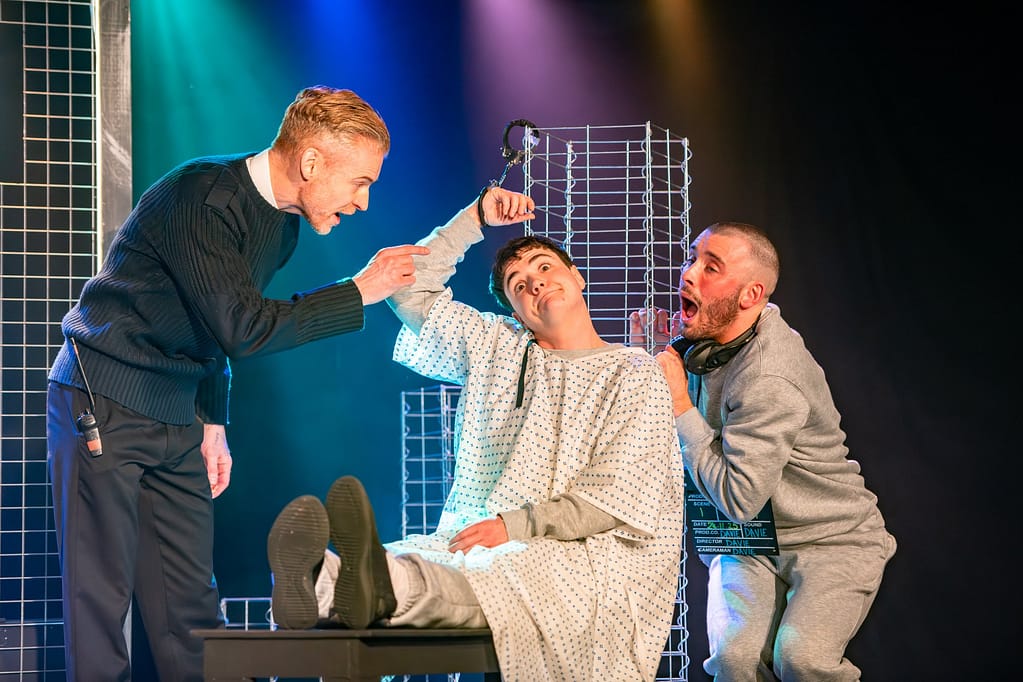
Images from The Legend of Davie McKenzie’ (at Òran Mór’s ‘A Play, a Pie & a Pint’) by Stephen Christopher and Graeme Smith. Photography by Tommy Ga-Ken Wan.
In Scottish Youth Theatre’s recent ‘Flip the Script’ workshop, playwright Douglas Maxwell explained that when describing your story, you’ll know its premise upon reaching the word ‘but’. We begin with the familiar details, establishing people and dynamics that the audience can place. Then, the ‘but’ signals a shock, prompting questions and consequences which give it its flavour. Though the pattern remains, ‘The Legend of Davie McKenzie’ turns this relationship inside-out. It first presents us with the foreign image of a grieving prisoner, and then later introduces the simple premise – the ‘but’ – of honouring his friend. Through this re-arrangement, Sean becomes less defined by his problems than his resolve. And though his mission is ultimately an impossible one, that’s part of the point. It’s his fierce commitment to it – to preserving Davie’s dignity – that reveals more than any transgression can. Above all, it portrays his humanity, something which has been stripped from many of his real-life counterparts.
According to Douglas, the essence of ‘theatricality’ comes from the commitment that a play solicits from its audience; the act of ignoring any evidence of imitation (stage, lights, etc.) and choosing to take part in a game of make-believe. Humour has a special ability to facilitate this process. Stephen and Graeme
described it as a “disarming effect”, one which enables the audience to let their guard down and indulge the dreams of a character they may be nothing at all like. Laughter also has the defining feature of being out loud. It’s an explicit admission of engagement, concrete evidence that the audience is agreeing to play
this game. “In some ways, as playwrights, we’re more like DJs”, Douglas explained. And that analogy has an appealing intuition; where a DJ’s choice of music is an invitation to dance, a playwright’s choice of words is an invitation to imagine.
By craftfully pulling the lever of laughter, the writers of ‘The Legend of Davie McKenzie’ demonstrate humour’s profound capacity for prompting meaningful reflection. Their approach starts with perhaps the greatest challenge: embracing the comedy latent in our own pain. From there, however, reality need not be so binding. Manipulating circumstance and embracing contradiction can be vast planes for refreshing, often outrageous comedy. Characters are wonderful vessels for this, affording freedom and flexibility without compromising on the message at heart. As Stephen and Graeme’s work exemplifies, this kind of theatricality is much more than a distraction. It serves as a means of demystifying our struggles, reincarnating them through the universal language of laughte
Sebastian is an aspiring writer, director, and producer. His credits include two original shows at the Edinburgh Fringe (‘Last Night at Loco’s’, 2023; ‘No Place Called Home’, 2024), a bi-weekly column (‘Our Homes’ in The Rattlecap), and a handful of poetry publications. Raised as a third-culture kid, his writing explores social and environmental crises, with a focus on the consequences that permeate our personal lives. He also has a degree in Business and Economics from the University of Edinburgh.
Also a quick reminder to let us know what you would liked covered on Dialogue – subject areas and particular topics are always welcome so drop us a message via one of our many social platforms.
Scottish Youth Theatre is a charity, and, while we get some public subsidy, we need to raise just as much in other ways every year to deliver our projects. Support us with a small donation to reach more young artists in more places. Click this link to donate as little as £5.