I’m Margot, I am a Venezuelan/Welsh early-career performance maker, facilitator, and producer working in multidisciplinary performance, movement and video art. I was one of the Trajectories artists in 2025, where I created my new performance piece ‘el mar entre nosotros’ (the sea between us); an intimate performance merging movement, text, and immersive video projection. The work is an exploration of bodies of water as archives of movement and diaspora, excavating my mixed roots from across Latin America and Europe, and about finding belonging in the constantly changing, moving, flowing states of the sea.
To me, movement is different to dance or physical theatre. The latter two are distinct disciplines with rich histories that offer a wealth of theory and techniques, however they can also both connote an exclusivity or inaccessibility. Whereas movement is just what it says on the tin. Movement. And everyone can move. There is no right way or wrong way, because movement just means the way that you move your body and interact with the world around you. For me, movement is intrinsically honest and natural, but also completely performative and manipulative. And in the context of contemporary performance or theatre, it’s about how you use your body to communicate and express a theme or story you are sharing.
Devising Movement
1. SONIC MOVEMENT
I begin any process of creating a show by making a playlist. In the playlist, I include any songs that I think relate to the themes, emotions, topic, sonic atmosphere, cultural sphere, or tone of how I imagine the piece. It’s not necessarily music I think might be used in the show, but anything that inspires building the world of the performance; including songs, sound recordings of nature, short podcasts, poetry readings, just beats or instrumentals – anything and everything, creating a type of sonic mood board. This playlist is my collaborator for the rest of the process, especially when creating solo work, it’s something to be in conversation with while building a show.
From there, I will begin to further develop a performance – narrowing down a theme, the stories I want to tell and how I want to tell them. I’ll write texts, create the design and visual elements, and other creations depending on the show. And of course, begin to create movement. There are endless methods and practices to create movement and choreographies. But when developing ‘el mar entre nosotros’ for Trajectories, I had to condense and pick a few methods to fit into our 6-week process, including the following…
2. SOMATIC MOVEMENT
I find that sometimes you need a soft entry into making movement, a way to check in with your body and see what is coming out without much thought or prompting.
I begin by putting on the playlist I’ve made and I begin to move freely. Dancing, stretching, posing – finding what my body wants and needs to do – and doing it. This is often called free or somatic movement; ‘somatic’ meaning “of or relating to the living body”. Therefore, I would define somatic movement as movement that is practised by consciously listening to the internal experience of the moving rather than focusing on its external appearance or end result.
At these early stages, the intention is just to understand where your body is at that moment, and to begin developing your own unique movement language: understanding how your body moves; how it responds to the themes and feelings you’re exploring; finding the type of movement that already exists internally and bringing it into action.
I also find it useful to journal or write after you move or dance, as it can often inspire and begin to lead you into the stories you want to tell while exploring your theme and creating text material you might choose to use in your performance.
3. USING MATERIALS AS COLLABORATORS
When making solo movement work I often work with natural materials and projection/video. With these elements; which can extend to set design, props and any other type of AV or design element, they become another collaborator in the space: another mover.
When I was creating ‘el mar entre nosotros’, my first inspirations for choreography came from moving with a large bed sheet, trying to find movements that looked and felt similar to ocean water. These movement explorations included simple actions to resemble water like:
● Twirling the fabric into a circle
● Waving the fabric up and down
● Pulling and stretching the fabric
● Laying the fabric out in the form of a stream
● Being under the fabric and reaching up
I then took away the fabric and repeated the actions as if I were still using the material. And I’m left with a choreography about the feeling and texture of water. This is one example of how using a prop can create a simple movement sequence.
CREATING A MOVEMENT-BASED PERFORMANCE
After devising movement I’ll go on to creating choreographies and structuring the performance. This is a brief breakdown of that process.
1. FILMING AND NOTATION
This really comes in much earlier (from the first day of rehearsal), but becomes essential when you need to remember everything you’ve made.
Film Everything. Every moment in the studio or rehearsal room.
Every moment of inspiration; everything you make. Film it.
I film most of my rehearsals, and it’s helpful for many reasons. This way, you have a record of your entire process, so you can understand how you got to something, but also because you might find interesting bits of material you thought was just a warm-up or unimportant movement. Watching yourself back is also a great practice, as you can observe and watch what your movement is like, put yourself in your audience’s shoes, and give yourself feedback.
I’ll make notations of all my material and begin to form movement sequences (bits that go together) and name each moment. There is really no right or wrong way to notate, I find the best is to try a variety of ways; whether that’s drawing your movement, or writing a list of all the actions – whatever will help you remember.
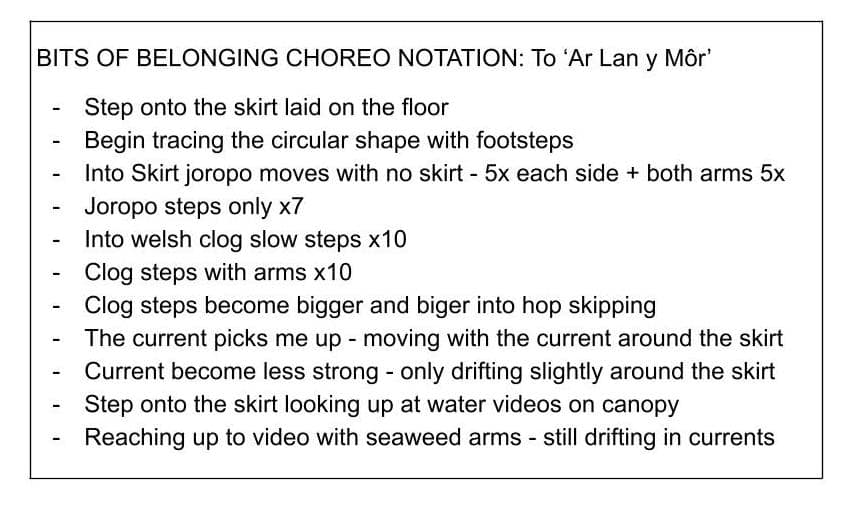
2. CREATING CHOREOGRAPHY AND STRUCTURING
Once I’ve watched all my rehearsal footage and began notating sequences, I’ll put everything onto post-it notes or small cards. And that’s when the structuring begins. I’ll lay out everything I’ve made and begin live storyboarding: putting things in an order and trying it out, combining sequences, mixing movement and text, trying movements to different songs etc.
Here’s an example of one storyboard I formed while creating ‘el mar entre nosotros’:
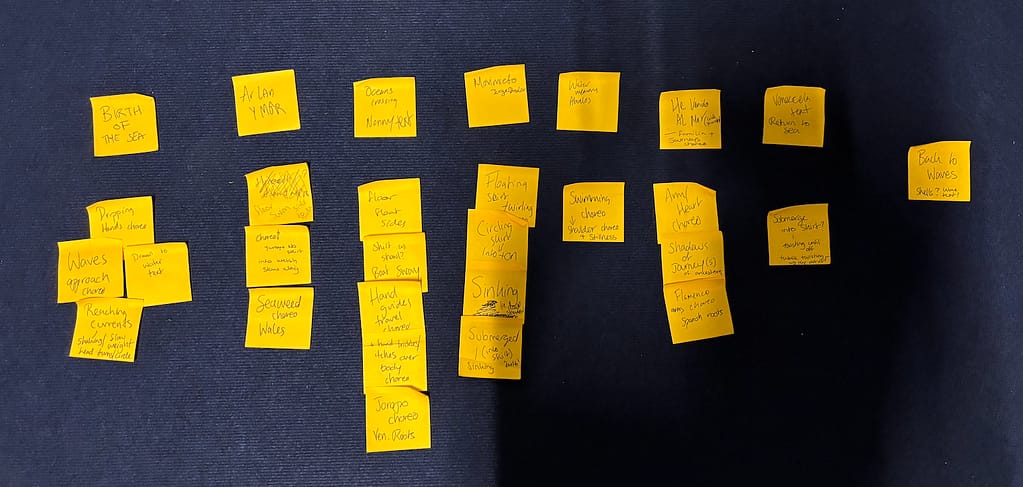
This is when the performance really begins to take shape. While creating ‘el mar entre nosotros’ I spent a lot of time playing with moments in different orders, finalising what sequences of choreography best fit certain texts or songs. This is how I found the journey of the piece and what I wanted to share with an audience about experiences of diaspora through the archival memories of the ocean.
From this process, I’m able to explore each movement or sequence in detail – paying attention to what each body part is doing when it’s not moving, what my face is doing, asking myself; “what is the intention behind each movement and what do I want to say through it?”
These types of questions guide me through most of the devising process, but feel most present at the end. Because the powerful thing about movement is that it can be interpreted in so many different ways; connecting diverse groups of people without language. And perhaps movement can reflect truths and stories that lie beneath the surface, that can only be understood and expressed through the body.
– Margot
Margot Conde Arenas is a Venezuelan/Welsh multidisciplinary performance maker, facilitator and producer working in live performance, video art and movement. Her practice focuses on amplifying silenced stories, encountering and transgressing memory in our bodies, and embracing imagination as a means of creating radical conversations and change. Delving into themes of decoloniality, migration and displacement, womanhood and ancestry, she aims to seek out the unspoken, the unwritten and the forgotten.
Scottish Youth Theatre is a charity, and, while we get some public subsidy, we need to raise just as much in other ways every year to deliver our projects. Support us with a small donation to reach more young artists in more places. Click this link to donate as little as £5.